AI Marketing Automation Dashboard: A Strategic Tool for Smarter Campaign Decisions
Marketing teams and product managers today face an overwhelming volume of data. Every campaign generates clicks, impressions, conversions, and cost metrics. Without a system to make sense of that information, decision-making becomes reactive rather than intentional. An AI marketing automation dashboard addresses this challenge by combining real-time analytics with intelligent recommendations in a single, visually coherent interface. Tools like Neurafy represent a new wave of dashboard design that prioritizes clarity, speed, and actionable insight over raw data overload. But adopting such a tool requires more than curiosity. It demands a clear understanding of your goals, your team’s workflow, and the specific outcomes you want to improve.
What Makes an AI Marketing Automation Dashboard Different
A standard analytics dashboard shows you what happened. An AI marketing automation dashboard goes further by helping you understand why it happened and what to do next. The difference lies in the integration of predictive models, pattern recognition, and automated recommendations into the same view where you monitor campaign performance.
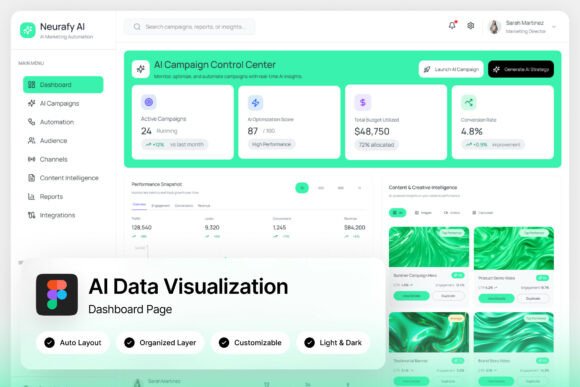
When you look at a dashboard like Neurafy, you see campaign control panels alongside audience metrics, conversion tracking, and performance graphs. The green-and-dark color scheme is not just aesthetic. It reduces visual fatigue and draws attention to key data points without distraction. But the real value is beneath the surface. AI-powered modules can surface trends in audience behavior, flag anomalies in conversion rates, and suggest budget adjustments before a campaign underperforms.
For marketing teams, this means less time hunting for insights and more time acting on them. For agency designers and product managers, it means a pixel-perfect layout that can be customized without breaking the underlying logic. The combination of light and dark mode options, well-organized layers, and easy editing makes it a practical choice for both internal teams and client-facing work.
Why Strategic Use Matters More Than Feature Count
It is easy to be impressed by a dashboard with many charts, filters, and export options. But the most powerful dashboard is useless if it does not align with how your team actually makes decisions. An AI marketing automation dashboard should support your existing planning processes, not replace them with complexity.
Before adopting any dashboard, consider what decisions you make most frequently. Are you optimizing ad spend weekly? Reviewing audience segments daily? Reporting to stakeholders monthly? The dashboard you choose should make those tasks faster and more accurate. If it adds steps or requires significant training to interpret, the cost of adoption may outweigh the benefit.
Neurafy, with its clean interface and grouped layers, is designed for teams that want to move quickly. But its effectiveness still depends on the quality of the data you feed into it. A dashboard is only as good as the metrics you choose to track and the goals you set. Without clear objectives, even the most sophisticated AI modules will generate noise instead of direction.
Aligning Dashboard Insights with Your Marketing Goals
Every marketing team operates within constraints. Budget, time, and talent are finite. An AI marketing automation dashboard helps you allocate those resources more effectively by highlighting where your efforts generate the highest return.
Start by mapping your primary goals. If brand awareness is the priority, focus on impressions, reach, and share of voice. If conversion is the target, track click-through rates, cost per acquisition, and lifetime value. A well-designed dashboard allows you to toggle between these views without losing context. The campaign control panels in a tool like Neurafy give you that flexibility, letting you monitor multiple objectives simultaneously.
The strategic advantage comes from the AI layer. When the dashboard flags that a particular audience segment is responding better than others, you can shift budget accordingly. When conversion tracking shows a drop in performance, you can pause underperforming creatives before they drain your budget. These decisions become routine rather than reactive when the dashboard surfaces them automatically.
This kind of alignment also supports long-term planning. By reviewing performance data over several months, you can identify seasonal patterns, test creative approaches, and refine your targeting strategy. The dashboard becomes a record of what works and what does not, which is invaluable for onboarding new team members or justifying budget requests to stakeholders.
Practical Use Cases for Marketing Teams and Independent Professionals
The value of an AI marketing automation dashboard extends beyond large agencies. Small business owners, freelancers, and solo practitioners can benefit just as much from structured data visualisation and intelligent recommendations.
Consider a product manager launching a new feature. With a dashboard like Neurafy, they can monitor adoption rates, user feedback, and campaign performance in one place. Instead of switching between multiple tools, they get a unified view that saves time and reduces errors.
For a content creator managing multiple platforms, audience metrics become critical. Knowing which content drives engagement and which falls flat allows better planning. The AI modules can highlight trends in audience behavior, such as when your followers are most active or which topics generate the most comments.
Marketing teams running A/B tests can use conversion tracking to determine which variant wins faster. Instead of waiting for manual analysis, the dashboard can flag statistically significant results and suggest next steps. This speeds up iteration and improves campaign performance over time.
Agency designers can use the dashboard as a client reporting tool. With a pixel-perfect layout and customizable layers, presenting campaign results becomes a professional, polished experience. Clients appreciate clarity, and a well-designed dashboard communicates competence and attention to detail.
Planning Your Approach Before Adopting a Dashboard
Adopting an AI marketing automation dashboard should not be an impulse decision. Like any tool, its value depends on how thoughtfully it is integrated into your workflow.
Start by auditing your current data sources. Which platforms do you use for advertising, email, social media, and analytics? Does the dashboard support connections to those tools? Some dashboards require manual data uploads, while others offer integrations. Understanding this upfront prevents frustration later.
Next, define who will use the dashboard and how often. A product manager may need daily access, while a freelancer may only review weekly. The interface should match the user’s level of data literacy. Neurafy’s well-organized layers and clean design make it accessible to both experienced analysts and those newer to data interpretation.
Consider also the visual preferences of your team. Light and dark mode options, like those included in Neurafy, allow users to choose what works best for their environment and reduce eye strain during long sessions. Small details like these impact adoption rates and long-term satisfaction.
Finally, plan for iteration. No dashboard is perfect on day one. You will likely need to adjust metrics, reorganize views, or add new data sources as your campaigns evolve. Choosing a tool that supports easy editing and customization ensures it remains useful as your needs change.
Understanding the Risks of Using Automation Without Clarity
Automation can amplify both good and bad practices. An AI marketing automation dashboard that recommends actions based on flawed assumptions or incomplete data can lead to poor decisions at scale.
The most common risk is over-relying on the dashboard without questioning its logic. AI models are trained on historical data. If your market conditions change rapidly, the recommendations may lag behind. For example, a sudden shift in consumer behavior during a crisis may not be reflected in the model’s predictions. Human judgment remains essential.
Another risk is data fatigue. When a dashboard surfaces too many metrics, it becomes difficult to identify what matters. The result is either paralysis or random action. To avoid this, limit your dashboard to the metrics that directly support your current goals. Additional data can be available through deeper layers, but the main view should be focused.
There is also the risk of confirmation bias. If you already believe a campaign is performing well, you may interpret ambiguous data as positive. An AI dashboard can counteract this by flagging anomalies and highlighting areas that need attention. But only if you are willing to look at data that challenges your assumptions.
Finally, consider data privacy and security. Any dashboard that connects to advertising platforms or customer databases should comply with relevant regulations. Ensure that the tool you choose handles data responsibly and that your team follows best practices for access control and data retention.
How to Evaluate a Dashboard Like Neurafy for Long-Term Value
When assessing a specific tool like Neurafy, look beyond the visual design to the underlying architecture and flexibility.
The resolution of 1440x1024 pixels ensures the dashboard displays well on standard monitors and laptops. This might seem like a technical detail, but it affects usability. A dashboard that requires constant scrolling or zooming slows down decision-making.
The inclusion of a Figma file (.fig), help guide, and font links makes it easy for design teams to customize the interface. If you work in an agency setting, the ability to rebrand the dashboard for different clients is a significant advantage. The well-organized, named, and grouped layers reduce the time needed to make changes.
Consider also the long-term support for the tool. Does the provider offer updates or new templates? Is there a community of users you can learn from? While a static dashboard can be useful, one that evolves with industry trends will serve you better over time.
The light and dark mode interface is another factor worth considering. Teams that work across different environments will appreciate the flexibility. Dark mode is particularly useful for presentations or late-night analysis sessions, while light mode may be preferable for printed reports or bright offices.
Finally, think about the learning curve. Even the most powerful dashboard is ineffective if team members avoid using it. Neurafy’s intuitive layout and pixel-perfect design help reduce friction, but you should still allocate time for training and experimentation during the first few weeks of adoption.
Final Thoughts on Building a Results-Driven Marketing Stack
An AI marketing automation dashboard is not a magic solution. It is a tool that, when used intentionally, can improve the speed and quality of your marketing decisions. The key is to start with clarity about your goals, choose a dashboard that aligns with your workflow, and remain willing to question the data it presents.
Whether you are a solo freelancer or part of a large marketing team, the principles are the same. Define what success looks like. Track the metrics that matter. Use automation to reduce repetitive work, but keep human judgment at the center of your strategy.
Tools like Neurafy offer a well-designed starting point. With its AI-powered modules, campaign control panels, and clean visual hierarchy, it supports the kind of focused analysis that leads to better outcomes. But the real value comes from how you use it. When you combine a thoughtful dashboard with clear objectives and a willingness to adapt, you create a foundation for sustainable marketing performance.
Take the time to plan your approach, test your assumptions, and refine your metrics over time. That is how a dashboard becomes more than a display. It becomes a decision-making partner that helps you move from data to action with confidence.