How a Modern Vector Email Signature Template Elevates Your Brand Identity
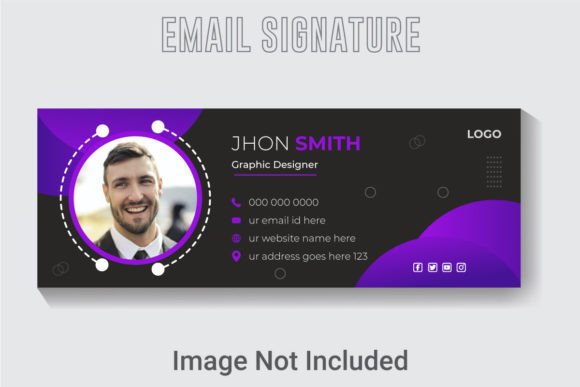
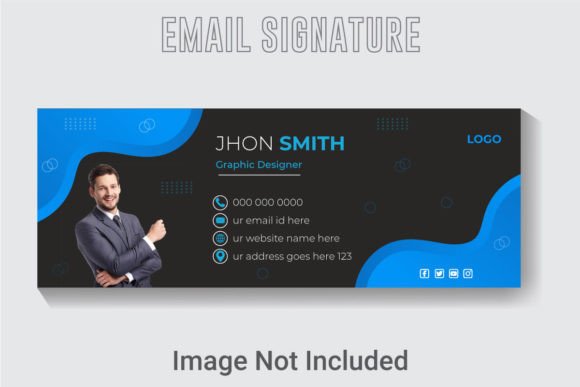
In today's digital-first world, every email you send is an opportunity to reinforce your brand. Yet many professionals overlook one of the most consistent touchpoints they have with clients, colleagues, and prospects: the email signature. A modern vector email signature template in 851x315 pixel RGB color design at 300 DPI resolution offers a polished, professional solution that goes far beyond the default "Sent from my iPhone" tagline. Whether you are a freelancer, a small business owner, or part of a large marketing team, understanding what makes these templates powerful can transform your email communication from forgettable to memorable.
This article walks you through everything you need to know about modern vector email signature templates—what they are, why the specific dimensions and resolution matter, how the file formats work, and how you can customize every element to fit your brand. By the end, you will have a clear understanding of why this tool belongs in your professional toolkit.
What Is a Modern Vector Email Signature Template?
A modern vector email signature template is a pre-designed layout that you insert at the bottom of your email messages. Unlike a simple text signature, these templates incorporate graphic elements such as logos, icons, social media links, contact details, and sometimes even banners or call-to-action buttons. The term "vector" refers to the fact that the design is built using mathematical paths rather than pixels, which means it scales infinitely without losing quality. This is a game-changer for email signatures because it ensures your design looks crisp on every screen—from a 5-inch smartphone to a 27-inch monitor.
The template described here comes in a specific dimension: 851 pixels wide by 315 pixels tall. This aspect ratio (roughly 2.7:1) is carefully chosen to fit seamlessly into the standard email width of most clients without being too tall or too wide. It provides enough horizontal space for a balanced layout while keeping the signature compact enough that it doesn't overwhelm the message body.
Why 851x315 Pixels at 300 DPI?
You might wonder why these particular numbers matter. The 851-pixel width aligns with common email client rendering widths, especially for desktop clients like Outlook and Apple Mail. When you design at 300 DPI (dots per inch), you are effectively creating a print-quality file. Even though email is a screen medium, starting at 300 DPI ensures that any raster elements (like photographs or textured backgrounds) remain sharp, and it gives you flexibility if you ever want to repurpose the design for print materials like business cards or letterheads.
The RGB color mode is essential for digital use. RGB (red, green, blue) is the color space of screens, while CMYK (cyan, magenta, yellow, black) is used for print. Designing in RGB means the colors you see on your screen will match what your recipients see when they open your email. This is especially important for brand consistency—your signature should display the exact shade of your brand blue or green every time, on every device.
Key Features of a Well-Structured Email Signature Template
Modern vector email signature templates are not just about aesthetics; they are built with functionality in mind. Here are the core features that make them effective:
- Fully Editable Text and Fonts: Every line of text, from your name and title to your phone number and website URL, can be changed. The fonts are included as standard or free fonts, meaning you can swap them out without licensing issues. Most templates use web-safe or commonly available fonts so that your signature displays correctly across all email clients.
- Editable Colors: The color palette is fully customizable. Whether you want to match your brand guidelines or experiment with a new look, you can adjust the hex values or use the color picker in Adobe Illustrator to change every element.
- Vector Graphics and Icons: Because the template uses vector shapes, the icons (like phone, email, location, and social media logos) remain sharp at any size. You can resize them without worrying about pixelation.
- Well-Layered Organization: The template files are organized into logical layers. This means you can easily hide, lock, or edit specific parts of the design without accidentally moving something else. For example, the background layer might be separate from the icon layer, and the text layer is isolated for quick edits.
- Social Media Integration: Most modern templates include clickable icons for LinkedIn, Twitter, Instagram, Facebook, and other platforms. These are usually linked to your profiles, so recipients can connect with you with a single click.
- Call-to-Action Options: Some templates include a small banner or button—for example, "Book a Consultation" or "Download Our Free Guide"—which can drive engagement directly from your emails.
The Three File Formats: AI, EPS, and JPG
When you purchase or download a modern vector email signature template, you typically receive three core files. Each serves a different purpose:
Adobe Illustrator (AI) File
The AI file is the master file. It is the native format of Adobe Illustrator, the industry-standard vector design software. This file retains all the layers, effects, fonts, and editable elements. If you have access to Illustrator (or a compatible vector application), you can open this file and customize every aspect of the signature. This is the file you will use for making changes, adjusting colors, swapping icons, and exporting the final version.
Encapsulated PostScript (EPS) File
The EPS file is a widely compatible vector format that can be opened in many different design programs, including older versions of Illustrator, CorelDRAW, and even some free tools like Inkscape. EPS files preserve the vector data, so you still get infinite scalability. If you are working in a team that uses different software, the EPS file acts as the universal bridge. It also retains layers in many cases, though not always as robustly as the native AI file.
JPEG (JPG) File
The JPG file is a raster image export of the template. This is the final, flat version of the signature. You cannot edit the text or colors in a JPG, but you can use it immediately in email clients that only accept static images. Many people use the JPG as a reference to see what the finished signature should look like, or they insert it directly into their email settings if they do not have design software. Keep in mind that JPG does not support transparency, so the background will be solid (usually white or a fixed color).
How to Customize Your Vector Email Signature Template
Customizing a template is straightforward if you follow a logical workflow. Let's walk through the process step by step:
- Open the AI file in Adobe Illustrator CC (or a compatible vector editor). The template should open with all layers visible. Look at the Layers panel to see how the design is organized.
- Edit the text. Select the text tool and click on the placeholder name, title, phone number, and email address. Type your own information. If the font is missing, you can either install the free font (which is usually included in the download folder) or choose a different font that matches your brand. The template description says "free font used," so you can legally download and use it without any extra cost.
- Adjust the colors. If your brand uses specific colors, select the elements you want to change (backgrounds, icons, text) and apply your brand's hex codes. Because the file is well layered, you can change the color of the entire signature in just a few clicks.
- Replace icons or images. If the template includes a profile photo or logo, you can easily swap it with your own. Use the "Place" command to insert your image, then scale and position it within the designated area.
- Add or remove elements. Maybe you want to include an additional phone number or remove a social media icon. Because the design is vector and layered, you can delete, add, or rearrange elements without breaking the layout.
- Save your final version. Once you are happy with the design, save a copy as an AI file for future edits, export a PNG or JPG for use in email clients, and consider exporting a high-resolution PNG with transparency if your email client supports it.
How to Add Your Signature to Popular Email Clients
Once your design is ready, you'll need to insert it into your email platform. The approach varies slightly depending on which client you use:
- Gmail: Go to Settings > See all settings > Signature. Create a new signature, then upload your exported signature image (PNG or JPG) directly. You can also use a signature generator tool if you want clickable links—some platforms let you paste HTML code for an interactive signature.
- Outlook (Desktop): Go to File > Options > Mail > Signatures. Create a new signature, then insert your image. Outlook allows you to add hyperlinks to the image so that clicking your logo or social icons directs recipients to your website or profiles.
- Apple Mail: Go to Mail > Preferences > Signatures. Create a new signature and paste your signature image. For clickable links, you can create a signature using HTML in a text editor and paste it directly.
- Other clients (Thunderbird, Yahoo, ProtonMail): Most modern email clients support inserting an image as a signature. Some also support rich HTML signatures, which allow for clickable buttons and linked text.
One common challenge is that some email clients (especially Outlook) may compress or resize images. Designing at 300 DPI and using the correct 851x315 pixel dimension helps mitigate this. It is also a good idea to keep the file size under 100 KB to ensure fast loading.
Common Misunderstandings About Email Signature Templates
Let's clear up a few misconceptions that often arise:
"Email signatures need to be plain text to look professional." This used to be true in the early days of email, but modern design tools and email client capabilities have evolved. A well-designed signature with a clean layout, proper spacing, and subtle graphics actually signals professionalism and attention to detail. The key is to avoid clutter—stick to essential information and one or two visual elements.
"Vector files are only for print designers." Vectors are just as useful for digital design. Because email signatures are viewed on screens of vastly different sizes and resolutions, vector-based designs ensure that your logo and icons look sharp everywhere. Plus, if you ever need to print your signature on a business card or brochure, you already have the high-resolution artwork ready.
"Once I add my signature, I can't change it without redesigning." Not true. Because the template is built in a well-layered, editable format, changing a phone number or updating a social link takes just a few seconds. You can keep the AI file on hand and make updates as your information changes.
Practical Relevance for Business, Freelancers, and Teams
Email signatures are often an afterthought, but they carry significant marketing weight. Every email you send is an impression of your brand. A polished signature can:
- Build trust by showing that you pay attention to the small details.
- Drive traffic to your website, blog, or landing page through clickable buttons or links.
- Grow your social following with integrated social media icons.
- Provide essential contact information so recipients never have to search for your phone number or email address.
- Create consistency across team members. If you are in a company with multiple employees, using the same template (with individualized names and titles) creates a cohesive brand presence in every email sent from the organization.
For freelancers, the signature serves as a mini portfolio. Include a link to your portfolio or a recent project. For educators, it can include office hours or a link to a course page. For creatives, it can showcase a small version of your latest work. The template's flexibility means you can adapt it to almost any context.
Why Adobe Illustrator CC and Free Fonts Matter
The template is built for the latest version of Adobe Illustrator CC, which is the leading vector design application. Using the CC version ensures compatibility with modern features like cloud libraries, easier font management, and responsive scaling. The inclusion of free fonts is a thoughtful touch—you do not need to purchase expensive typefaces to make the template look professional. Free fonts such as Montserrat, Roboto, Open Sans, or Lato are common choices because they are clean, readable, and available for commercial use without licensing fees. Always confirm the specific font license included with your template, but in most cases, free fonts are safe for business use.
Final Thoughts on Choosing a Modern Vector Email Signature Template
A well-designed email signature is not a luxury; it is a necessity in a world where digital communication often replaces face-to-face meetings. The modern vector email signature template described here—with its 851x315 pixel RGB design at 300 DPI, well-layered AI and EPS files, and fully editable text, fonts, and colors—gives you everything you need to create a signature that is professional, consistent, and memorable. Whether you are a one-person operation or part of a global team, taking the time to set up a signature that reflects your brand will pay off in every email you send.
Remember, your email signature is often the last thing a recipient sees before deciding whether to reply, click a link, or follow you on social media. Make that last impression count.