Fast Food Social Media Post Template: Streamlining Visual Content for Quick-Service Brands
If you have ever managed social media for a fast-food restaurant, a café, or a takeout brand, you know how demanding it can be to keep up with daily posts. Between promoting limited-time offers, sharing mouthwatering food photography, and announcing loyalty rewards, the need for consistent, eye-catching visuals never stops. This is exactly where a Fast Food Social Media Post Template becomes a game-changer. It offers a ready-made design framework that helps you create polished, brand-aligned content in minutes, without starting from scratch every time.
What Exactly Is a Fast Food Social Media Post Template?
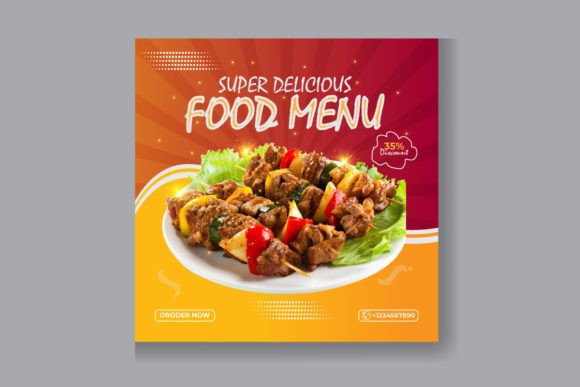
A Fast Food Social Media Post Template is a pre-designed graphic file—or a set of files—built specifically for quick-service restaurants and food brands. Typically delivered in formats like EPS, AI, and JPG, these templates are optimized for a standard 1080×1080 pixel square layout, which works perfectly across Instagram, Facebook, and other major platforms. The file package usually includes one EPS file, one AI file, and one JPG preview, all set to 300 DPI in RGB color mode. This means you can edit the template in Adobe Illustrator or similar vector software, change text, swap images, adjust colors, and export high-resolution posts ready for publishing. The template itself does not include stock images, so you supply your own food photos, but it provides the structural layout, typography hints, and decorative elements that give each post a cohesive, professional look. Plus, it uses free fonts, so you do not need to purchase expensive typefaces to get started.
Key Features at a Glance
- Easy to edit: Layers and smart objects allow quick customization, even if you have only basic design skills.
- Optimized for 300 DPI: Ensures crisp, print-quality rendering when needed, though primarily used for digital screens.
- RGB color mode: Standard for all digital displays, guaranteeing accurate color representation on monitors and mobile devices.
- 1080×1080 pixel size: Square format that fits perfectly into Instagram feeds, Facebook posts, and other social grids.
- 1 EPS file + 1 AI file + 1 JPG: Three formats give you flexibility—EPS for older vector workflows, AI for native Illustrator editing, and JPG for quick preview or direct upload.
- Images not included: You are free to use your own food photography, which keeps the design unique to your brand.
- Free fonts: Reduces additional cost and licensing complexity.
Who Can Benefit from This Template?
While the name points directly to fast-food chains, the template is surprisingly versatile. Here is a breakdown of who might find it most useful:
- Small business owners running a burger joint, pizza place, taco stand, or food truck who want consistent social media without hiring a full-time designer.
- Social media managers handling multiple restaurant accounts who need a repeatable, on-brand layout to speed up their workflow.
- Marketing professionals at fast-casual or quick-service brands who want to maintain visual consistency across campaigns.
- Freelance designers who create content for food clients and need a reliable starting point for each project.
- Startup food concepts launching a brand and needing a cohesive visual identity from day one.
Real-World Scenarios: How the Template Gets Used
Imagine you run a local fried chicken chain. Every week, you have a new daily special: Monday is spicy wings, Tuesday is a family bucket deal, Wednesday is a new dipping sauce. Without a template, you would have to design each post individually, which takes time and often results in inconsistent fonts, colors, and layouts. With a Fast Food Social Media Post Template, you open the AI file, drag in a fresh photo of the wings, update the text to say "Spicy Wings Monday," adjust the offer badge, and export. The entire process takes under ten minutes, and every post looks like it belongs to the same family.
Another example: a food blogger who reviews fast-food items might use the template to create visually consistent comparison posts. By keeping the same frame, logo placement, and text hierarchy, their audience immediately recognizes the content as part of a recurring series. This builds anticipation and brand recall over time.
For a marketing agency that handles seasonal campaigns for a burger chain, the template becomes the backbone of a month-long promotion. They create a version for each week, swapping out the hero image and offer details, while the core layout stays intact. This efficiency allows them to focus more on crafting the message and less on repetitive design work.
What Makes It Stand Out
- Time savings: The biggest advantage. Once your brand colors, logo, and font choices are set in the template, every subsequent post is a quick edit away.
- Consistency: A unified look across all social channels strengthens brand identity and makes your content instantly recognizable.
- Beginner-friendly: Even if you are not a professional designer, the template structure guides you to create balanced, attractive posts.
- Format flexibility: Having EPS and AI files means you can work with older or newer design software without compatibility worries.
What to Keep in Mind
- Images are not included: You need access to high-quality food photography. For best results, use well-lit, appetizing images that match the template's composition area.
- Free fonts may have usage limits: Always check the license of the free fonts included. Some may restrict commercial use, though most are open for business applications.
- Learning curve for editing: While the template is easy to edit, you still need basic knowledge of layer management, text tools, and export settings in Illustrator or a compatible program.
- Square format only: The 1080×1080 size is great for Instagram feeds and Facebook, but you may need to adapt it for story-sized (1080×1920) or landscape formats separately.
How to Evaluate If This Template Is Right for Your Needs
Not every template fits every brand equally. Here is a practical guide to assessing whether a Fast Food Social Media Post Template aligns with your workflow and goals:
- Check your design software: If you use Adobe Illustrator, the AI and EPS files are ideal. If you rely on Canva or other browser-based tools, you may need to convert the file or look for a PSD or Canva-native alternative.
- Assess your volume of posts: If you post daily or multiple times per week, the template pays for itself quickly in time saved. If you post once a month, a simpler approach might suffice.
- Look at the style: Some templates lean toward a modern, minimalist look; others are more playful or retro. Choose one that reflects your brand personality rather than forcing your brand into the template's style.
- Test the edit process: Open the AI file, change a few text fields, and swap an image. See if the layers are logically named and organized. A well-structured template saves frustration later.
- Consider the free fonts: Preview the fonts included. If they do not match your brand voice, you can replace them, but that adds extra steps. Ideally, the fonts should be close to what you already use.
Practical Tips for Getting the Most Out of the Template
Once you have the template, a few best practices will help you maximize its value:
- Set up a master file first: Before editing individual posts, create a master version with your permanent brand elements—logo, brand colors, recurring decorative elements. Save this as a separate file and duplicate it for each new post.
- Keep a folder of approved images: Build a library of high-resolution food photos that are cropped and color-corrected. This speeds up the swapping process and ensures consistent image quality.
- Maintain text hierarchy: The template likely has designated areas for headline, subtitle, and body text. Resist the urge to move elements around too much; consistency is key to recognition.
- Export in the right format: For Instagram and Facebook, JPG at 1080×1080 pixels works well. For ads or print materials, you can export PNG or TIFF from the original AI file.
- Test on mobile: After exporting, view the post on a phone screen. Text should be readable without zooming, and the focal point (the food image) should dominate the composition.
Why Content Creators and Business Owners Are Turning to Templates
The demand for visual content is higher than ever. A single brand may need dozens of social media posts per month, plus ads, stories, and promotions. Creating each piece from scratch is neither efficient nor sustainable. Templates like the Fast Food Social Media Post Template offer a middle ground—they are not a one-size-fits-all solution, but they provide a structured foundation that saves hours of repetitive work. For small businesses especially, this means more time to focus on food quality, customer service, and community engagement, rather than wrestling with design software.
Final Thoughts: Is It Worth Your Time?
If you are a fast-food brand, a content creator covering food trends, or a marketer handling multiple accounts, a well-designed template can become one of your most practical tools. It does not replace the need for strong photography or thoughtful copy, but it elevates both by presenting them in a polished, consistent frame. The key is to choose a template that feels like an extension of your brand, not a constraint. When used correctly, a Fast Food Social Media Post Template helps you publish faster, look more professional, and keep your audience coming back for more—just like your best menu items.
Before purchasing or downloading any template, always review the file compatibility, font licenses, and editing requirements. A few minutes of upfront evaluation can save you from frustration later and ensure that the template truly supports your social media strategy rather than complicating it.